11 Open-Ended Questions for Kids To Help Them Think Smarter
When you think about the conversations you have with your child, you may have noticed how easy it is to fall into yes-or-no exchanges that barely scratch the surface of what your child is capable of thinking about. If you have been looking for ways to help your child become more expressive, thoughtful, and confident in sharing ideas, focusing on open-ended questions for kids can change the way you both communicate.
You might even realize that the way you ask questions affects how your child learns to handle problems, make decisions, and understand the world. Many parents feel uncertain about how to get children to think more deeply, but shifting the style of their questions opens the door to meaningful conversations that expand their minds.
If you observe your child’s day, it becomes clear how they respond to simple questions. “Did you finish your homework?” “Are you hungry?” “Did you have fun?” These questions work for gathering information, but they rarely help your child develop reasoning.
You would have noticed that when you ask these quick questions, your child ends the conversation instantly. When this becomes a daily habit, children miss out on chances to build communication skills, emotional awareness, and problem-solving abilities.
Research from the Harvard Center on the Developing Child highlights that early communication experiences directly shape brain architecture, especially when children are taught to think and respond with their own ideas. When questions invite them to explore thoughts, imagine possible outcomes, or explain the reasons behind their choices, you give their brain the stimulation it needs for long-term cognitive growth.
11 Open-Ended Questions for Kids
1. What made you think that?
Ask this when your child shares an idea. It helps them explain their reasoning and support cognitive development by activating the brain’s areas responsible for logic and reflection. You also learn how your child interprets situations.
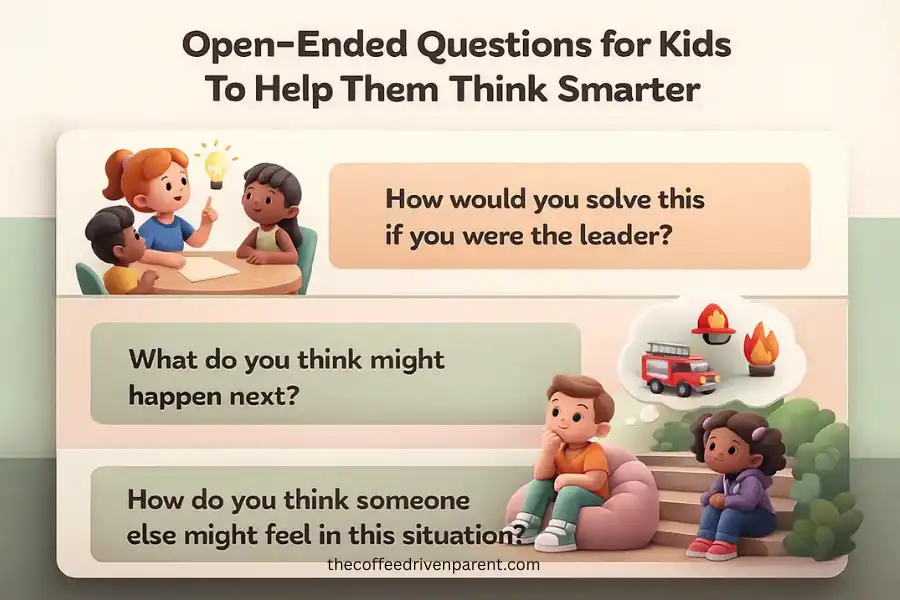
2. How would you solve this if you were the leader?
Children love imagining themselves in charge. This question helps kids in problem-solving and decision-making. Studies in leadership development for children highlight that giving kids hypothetical leadership roles builds confidence and autonomy.
3. What else could we try?
This question is powerful during moments of frustration or when a plan does not work. It teaches persistence and flexible thinking, abilities linked to higher resilience.
4. What do you think might happen next?
Whether you are reading a story or observing real-life events, this question helps children practice prediction, a core critical thinking skill. It lets you see how your child understands cause and effect.
5. If you could change one thing about today, what would it be and why?
This question develops reflection. Children learn to evaluate their experiences rather than simply describing them. Reflection is known to strengthen memory and emotional awareness.
6. What made that part difficult for you?
Instead of assuming why your child struggled, you let them explore it themselves. This supports emotional intelligence and teaches children to identify challenges without feeling judged.
7. How do you think someone else might feel in this situation?
This question builds empathy. Studies in child development consistently show that empathy grows when children practice perspective-taking. It teaches them to consider viewpoints beyond their own.
8. What would happen if we tried the opposite idea?
A simple but powerful question that strengthens creative thinking. It invites children to explore possibilities and think outside familiar patterns.
9. Why do you think that choice worked or didn’t work?
Children learn decision-making when they are allowed to reflect on outcomes. This helps them recognize patterns, evaluate results, and make thoughtful choices in the future.
10. What part of this are you most proud of?
This question builds self-esteem by helping children acknowledge effort rather than just outcomes. Research in motivation shows that inner motivation grows when children recognize their own strengths.
11. If you could teach someone this, how would you explain it?
Teaching requires understanding. When you ask your child to explain something as if they were the teacher, they organize their thoughts, clarify ideas, and deepen their comprehension. This method is supported by the “protégé effect,” which shows that learning improves when learners explain concepts to others.
Final Remarks
Something intriguing occurs once you begin using these questions. You start to gain a deeper understanding of your child’s thoughts as they become more talkative. You realise you used to underestimate their capacity for comprehension and explanation.
Your talks become more than just check-ins as your child opens up; they become essential discussions that benefit both of you. You might find yourself paying more attention, giving more thoughtful answers, and valuing your child’s unique perspective on the world.
I regularly remind parents that these questions are not required to be used efficiently. There isn’t a script. You can modify them to fit your regular interactions and your child’s personality. While some kids respond to open-ended discussions immediately, others need time to adjust.
What is important is your desire to sit down, listen, and invite deeper thinking. Children are more inclined to contribute when they perceive you as genuinely curious and patient. These discussions eventually become part of your relationship and contribute to a solid foundation of trust.
Additionally, you can see benefits in unexpected places. Children who consistently answer open-ended questions often get better at expressing emotions, navigating social situations, and resolving problems. They acquire the ability to consider things before acting, something even many adults find difficult.
Longer responses in talks help children expand their vocabulary and improve their sentence structure. You support verbal and emotional development in addition to improving mental skills.
Start with one question per day if you’re ever unsure of where to start. Before going to bed, in the car, or at dinner, ask it. You’ll notice that your youngster will seek out these talks more as they become more organic. They may even begin posing the same questions to you, showing their growing capacity for independent and inquisitive thought.
In a few months, you might realise that these little exchanges had a significant impact. Your youngster might grow more self-assured when discussing ideas, more considerate when resolving issues, and more forthcoming when expressing emotions. These are lifelong abilities that develop along with them.
In conclusion, complex techniques or specialised equipment are not necessary to support your child’s development of critical thinking skills. The way you speak to them is the first step. Asking children open-ended questions develops introspection, creativity, empathy, and problem-solving skills.
You have an impact on how your child perceives and engages with the world. You improve your relationship and build an atmosphere that values expression and thought. You’ll see how effective these 11 open-ended questions can be in influencing your child’s development and self-assurance as you continue to use them.
FAQs About Open-Ended Questions for Kids
What are open-ended questions for kids?
Open-ended questions for kids do not have a straightforward yes-or-no response. They help children to think more deeply, communicate openly, and provide thorough explanations of their ideas. By inspiring innovation, collaboration, and problem-solving, these questions expand the significance and interest of conversations.
Why are open-ended questions important for child development?
Children are pushed to think critically, speak well, and explore concepts through open-ended questions. These questions improve vocabulary, emotional comprehension, and cognitive flexibility. They help kids learn about different points of view, articulate their emotions, and make decisions.
How do open-ended questions improve critical thinking in kids?
Children are challenged by these questions to think critically, justify, and evaluate their beliefs. Rather than memorisation or guesswork, they need more in-depth thought. Regularly responding to open-ended questions helps kids develop their ability to analyse situations, weigh options, predict outcomes, and understand cause-and-effect relationships.
When should I ask my child open-ended questions?
During everyday activities, such as mealtimes, car journeys, bedtime, play, or homework, you can pose open-ended questions. The ideal moment is when your child is at ease and prepared to speak. The best talks are sparked by natural events, which also facilitate your child’s comfortable opening.
What is the difference between open-ended and closed-ended questions?
Quick responses to closed questions include “yes,” “no,” or brief information. Open-ended questions necessitate more in-depth analysis, lengthier answers, and justification. They promote children’s creative thinking, concept exploration, and sharing of experiences. While both kinds are helpful, open-ended questions develop better reasoning and communication.
How can parents use open-ended questions at home?
Open-ended questions can help parents get their kids to explain decisions, express emotions, or offer suggestions for activities throughout daily routines. Based on your child’s interests, start with straightforward questioning like “What do you think about this?” and progressively move on to more thoughtful or creative ones.
Do open-ended questions help emotional development?
Yes, they make it easier for kids to understand and communicate their feelings. Children gain emotional language, empathy, and self-awareness when asked open-ended questions about their feelings. Additionally, these discussions build trust and improve parent-child relationships.
Can open-ended questions improve communication in shy kids?
Shy kids are gently persuaded to speak without feeling pressured via open-ended questions. They feel more comfortable expressing their opinions because there is no “right answer.” Over time, these discussions decrease communication fear, increase self-expression, and boost confidence.
How many open-ended questions should I ask daily?
There isn’t a set amount. You can improve your child’s thinking and communication by posing one or two open-ended questions every day. Rather than quantity, the objective is regular, organic conversations. Quality is more important, and little daily routines have a lasting effect.
What are examples of good open-ended questions for kids?
“What made you think that?” “What would happen next?” “How else could we solve this?” “Why do you think that choice worked?” and “What part are you proud of?” are a few examples. These questions spark creativity, logic, and introspection.