11 Toxic Relationship Patterns Kids Learn From Parents
School, friendships, and milestones come to mind when discussing kids’ growth. However, a youngster is most shaped by the silent lessons they learn at home. Long before a youngster even knows what “healthy boundaries” or “mutual respect” mean, toxic relationship patterns are internalized.
Kids observe how you interact with others, resolve conflicts, treat your partner, and take care of yourself. The relationships kids will form as teenagers and adults are shaped by these early experiences. Kids learn from their parents when they are repeatedly exposed to these patterns ingrained in their emotional and mental development, and these patterns become their go-to relationship model.
11 Toxic Relationship Patterns Kids Learn From Parents
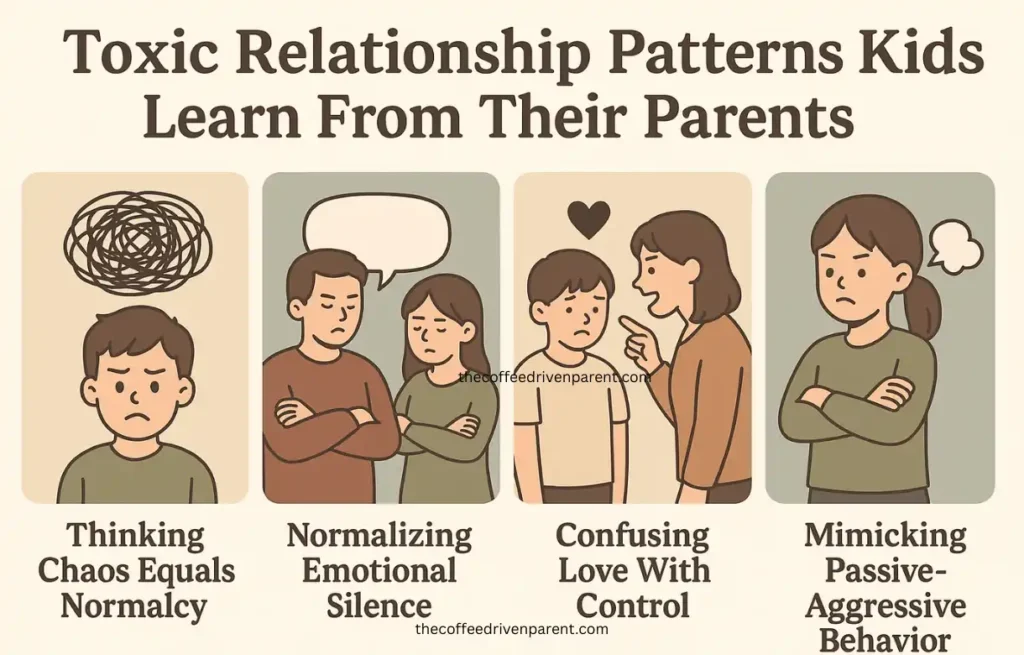
1. Normalizing Emotional Distance
A youngster quickly learns to adjust by suppressing their own emotional needs when raised in a household with little or no affection. Children who grow up with emotionally distant parents have avoidant attachment styles later in life, according to developmental psychology research.
You might not even be aware that your busyness, tiredness, or quietness during a disagreement conveys emotional absence. Your child eventually learns that intimacy is dangerous or superfluous. Even while they privately want connection, they learn to have lower expectations for partnerships.
Changing this pattern means showing your child that emotional presence is as essential as food or sleep. When you model honest conversations and empathy, they learn that intimacy is safe, not something to fear or avoid.
2. Treating Conflict as a Battle Instead of a Conversation
Your youngster will learn that conflict is something to be afraid of if there is a lot of shouting, blame, or sudden shutdowns in your family. According to American Psychological Association research, a child’s cortisol levels, attention span, and long-term coping abilities are all impacted by how parents handle conflict.
Children absorb emotional tension like a sponge, even though you may believe your child is not involved in your disagreements. They learn patterns: shouting shows authority, silence signals punishment, and apologizing indicates failure.
When you begin treating conflict as a moment to understand instead of overpower, your child learns that disagreements do not have to threaten love. They learn emotional regulation by watching you regulate your own reactions.
3. Confusing Control With Love
A youngster internalizes fear rather than guidance when control becomes the primary Mode of interaction, despite many parents’ belief that rigid rules will keep their child safe. Overly controlling children struggle with autonomy, self-identity, and decision-making as adults. Your youngster learns that relationships demand obedience rather than respect when you dictate rather than work together.
Your child will learn that respect is reciprocated if you move towards cooperation and allow them to make little decisions and exercise age-appropriate autonomy. Through this, they can see that selflessness is not a prerequisite for love.
4. Modeling Over-Apologizing or Never Apologizing
Kids observe how you mend connections. They learn that harmony involves self-erasure when you apologize too often, especially when it wasn’t your fault. They will realize that it’s dangerous to own up to your faults if you never apologize. According to research, children learn healthy accountability and emotional resilience via authentic mending. Your child must understand that apologizing is about taking responsibility, not feeling ashamed.
You allow your child to be flawed while still developing by engaging in balanced mending, which involves admitting your faults without becoming overly attached to them.
5. Using Sarcasm, Mockery, or Passive Aggression
A child’s relational pattern is shaped by subtle disrespect just as much as by overt animosity. Your child learns that love involves humiliation when you make sarcastic remarks or use sarcasm in your regular encounters, even when it’s made in jest. Kids who witness persistent passive hostility find it challenging to recognize their own feelings and to establish boundaries as adults. They might get the idea that communication ought to be emotive and indirect.
This can be changed by setting an example of direct communication by calmly expressing your own feelings. Your child discovers that kindness and honesty are compatible.
6. Normalizing Self-Sacrifice to the Point of Self-Neglect
By watching you, they learn how to treat themselves and others. Your child will know that their needs must likewise come last if you consistently disregard your own. According to research on emotional modelling, children of self-neglecting parents have difficulty expressing their emotions and feeling good about themselves. Your youngster perceives weariness, resentment, and a lack of personal boundaries, even if you may believe you are being strong.
You teach your child that self-respect is a necessary component of healthy love by taking care of yourself—resting, establishing boundaries, and putting your health first.
7. Teaching That Love Must Be Earned
In some households, a child receives attention and praise only when they do well on tasks, earn good grades, or achieve accomplishments. This amplifies conditional love. Conditional positive esteem has been linked to anxiety, perfectionism, and fear of failing as an adult. Your youngster will enter partnerships with the belief that they must continually try to win your affection if they feel that they must “earn” your attention.
When you offer warmth, affirmation, and presence without tying them to performance, your child learns that they are worthy simply because they exist.
8. Making One Parent the “Good Cop” and the Other the “Bad Cop.”
Your child learns about inconsistency and emotional division when parents adopt these roles: one is too harsh, the other excessively lenient. They begin to associate fear or uncertainty with one parent and safety with the other. Inconsistent parenting raises children’s anxiety, allegiance disputes, and emotional disorientation. They could become adept at manipulating relationships to achieve their goals or completely ignore responsibility.
Your child learns about consistent affection and expectations when both parents adopt an integrated, values-based approach rather than a role-based one.
9. Modelling Emotional Explosion Instead of Emotional Regulation
Your youngster internalises the cycle of escalation and regret when you repeatedly lose your temper, even if you later apologize. Children imitate their parents’ emotional management styles, particularly under stressful circumstances. When they witness you shutting down, slamming doors, or lashing out, they pick up similar coping mechanisms.
Your youngster learns a model for peaceful self-control when you stop, take a breath, and explain your emotional process (“I am frustrated, so I’m going to take a minute”).
10. Avoiding Hard Conversations
Kids pick up emotional bravery when they witness you approach challenging subjects honestly. They learn that discomfort must be avoided when you routinely avoid talking about emotions, money, boundaries, sadness, or mistakes. Children who grow up in emotionally distant households experience difficulties in the future with self-expression, vulnerability, and conflict resolution.
Encouraging your child to have regular, respectful conversations, even when they are awkward, teaches them that complex subjects don’t destroy relationships and that emotions can be expressed safely.
11. Demonstrating Unbalanced Power Dynamics
Your child will learn about distorted ideas of power by observing dominance, whether financial, emotional, or physical. Children raised in unequal interpersonal situations are more likely to enter similar partnerships as adults, either as the dominator or the dominated, according to research on intimate relationship modelling. They discover that one person must become more powerful, while the other must become smaller.
Your child learns that good relationships function as partnerships rather than hierarchies when you model equality through shared decision-making, mutual respect, and equitable responsibility-sharing.
How You Can Break These Toxic Relationship Patterns
To create a more positive emotional atmosphere, you don’t need to be an ideal parent. Children need awareness, mending, and presence rather than perfection. Your youngster gains instant benefits when you honestly examine your habits. Their brain adjusts. Their comprehension of emotions grows. Their views on love change.
You can begin by paying attention to your tone, slowing down your responses, apologizing more sincerely, and being emotionally present even on bad days. You can show consistency in your parenting style, set limits, and accept responsibility for your emotions.
Children absorb toxic relationship patterns thoroughly, even though they are rarely intentionally taught. Children’s emotional and interpersonal lives are shaped by the patterns they pick up from their parents through repeated behaviour.
However, knowledge enables you to change the narrative. Your child’s emotional and mental growth is strengthened when you set an example of love by promoting connection rather than distance, respect rather than control, and honesty rather than avoidance. You can set an example for your child to follow in developing positive relationships for the rest of their lives by making deliberate decisions.
FAQs About “Toxic Relationship Patterns That Kids Learn From Their Parents”
What are toxic relationship patterns?
Repeated actions that undermine communication, trust, and emotional safety are known as toxic relationship patterns. Control, manipulation, emotional distancing, criticism, envy, and ineffective conflict resolution are among them. Many people pick up these habits from their parents and carry them into adulthood, only becoming aware of them and making a conscious effort to change their behaviour.
How do kids learn toxic behaviours from parents?
Through observation, children pick up behaviours. They observe how parents interact, manage stress, settle disputes, display affection, or retreat. The youngster internalizes unhealthy patterns as “normal” when they recur. These behaviours subtly influence how individuals handle future love and friendship relationships.
What signs show you learned toxic patterns in childhood?
Common symptoms include fear of conflict, people-pleasing, defensiveness, emotional avoidance, jealousy, controlling tendencies, or shutting down when emotions surface. Additionally, you may attract emotionally distant partners, experience repeated relationship instability, or feel uncomfortable expressing your demands. These behaviours frequently reflect what you witnessed as a child.
How do toxic family dynamics affect adult relationships?
Communication, trust, and connection are all impacted by toxic patterns acquired during childhood. Boundaries, intimacy, conflict resolution, and emotional expression can all be difficult for adults who grew up in unstable households. Because the brain associates early patterns with comfort, they may select relationships that feel “familiar,” even if those partners are toxic.
Can toxic relationship patterns be unlearned?
Yes. Healthy behaviours can replace harmful ones with self-awareness, emotional education, and regular practice. Reshaping previous patterns can be aided by journaling, therapy, communication training, setting boundaries, and selecting emotionally secure companions. The brain can relearn better interpersonal abilities, but change takes time.
Why do people repeat toxic behaviours from childhood?
What seems familiar is repeated. Even unhealthy behaviours can appear “normal” because the brain creates emotional templates early in childhood. Even if it hurts, you might repeat what you saw in your parents if you don’t actively confront these templates, since it feels expected.
How do you break toxic relationship cycles?
Start by recognizing your triggers, reflecting on your childhood experiences, and learning healthier communication skills. Practice direct communication, emotional regulation, and boundary setting. Surround yourself with emotionally mature people and seek therapy if needed. Slowly replacing old habits breaks generational cycles.
Are toxic patterns always intentional?
No. Many people express toxic behaviours without realizing they’re harmful. Childhood experiences, stress, trauma, and learned responses shape these habits unconsciously. Becoming aware allows you to change them. Awareness—not blame—is the first step toward healthier relationships.
Can parents unintentionally teach toxic patterns?
Absolutely. Even loving parents can pass down unhealthy behaviours simply because they learned them from their own families. Children mirror tone, reactions, coping styles, and emotional habits. Toxic patterns are often generational, not malicious.
How do toxic relationship patterns affect mental health?
These patterns can cause anxiety, low self-esteem, fear of abandonment, emotional numbness, and difficulty trusting others. You may struggle to form stable, secure relationships. Over time, toxic habits create emotional exhaustion. Healing them supports long-term mental well-being.
What do children learn from toxic relationship patterns they see from their parents?
Children absorb the behaviour they see at home. If their parents fight often, manipulate or withhold affection, kids may think that arguing, emotional coldness or manipulation is “normal.” Over time, the child may copy those unhealthy patterns in friendships or romantic relationships.
Is it possible to break the cycle so children don’t repeat toxic relationship patterns?
Yes. Breaking the cycle starts with awareness. Parents or adults must reflect on harmful patterns, practice healthier communication and boundaries, and teach children how to relate with respect and empathy — even if that feels unfamiliar at first.
What are the signs that a child might be negatively affected by witnessing toxic relationships at home?
Signs may include withdrawing socially, low self-confidence, mood swings, anxiety or depression, trouble trusting others, or using silence/anger to communicate. Children may also replicate controlling or conflict behaviours in their own relationships.
How do toxic relationship patterns shape the way Kids Learn From Their Parents to communicate?
A: Children watching toxic communication—yelling, blaming, silent treatment—often copy those habits. They may think expressing needs is unsafe or that conflict means winning or losing. Over time, they repeat the same unhealthy communication style with friends, teachers, and future partners.
Do kids repeat toxic relationship patterns automatically because Kids Learn From Their Parents?
A: Kids tend to mirror what they see, not what they’re told. Even if parents teach kindness verbally, children follow observed behaviour. When toxic patterns are the daily norm, children absorb them unconsciously and may repeat them without realizing these behaviours are unhealthy.
How can parents stop passing down toxic relationship patterns when Kids Learn From Their Parents?
A: Parents can break the cycle by modelling calm communication, apologizing when wrong, setting boundaries, and showing empathy. Even small, consistent changes show children healthier ways to relate. Kids learn fastest by watching adults choose respect instead of toxicity.
Why do Kids Learn From Their Parents to ignore their own feelings in toxic relationship patterns?
A: When adults dismiss or shame children’s emotions, kids learn their feelings don’t matter. They may suppress emotions to avoid conflict or criticism. This teaches them to ignore discomfort in future relationships, making them vulnerable to emotional neglect or manipulation.
How do toxic relationship patterns affect future romantic relationships? Kids Learn From Their Parents?
A: Children often enter adulthood believing relationships mirror childhood. If they saw disrespect, chaos, or emotional distance, they may think love looks that way. This can lead to choosing unhealthy partners, tolerating mistreatment, or struggling to set boundaries.
Can Kids Learn From Their Parents to form healthy relationships even after growing up with toxic relationship patterns?
A: Yes. With awareness, therapy, supportive adults, and healthier role models, children and adults can relearn what safe relationships look like. Understanding the past helps them choose new habits—like honest communication, boundaries, and emotional responsibility.